Pokémon Catch Calculator & Simulator
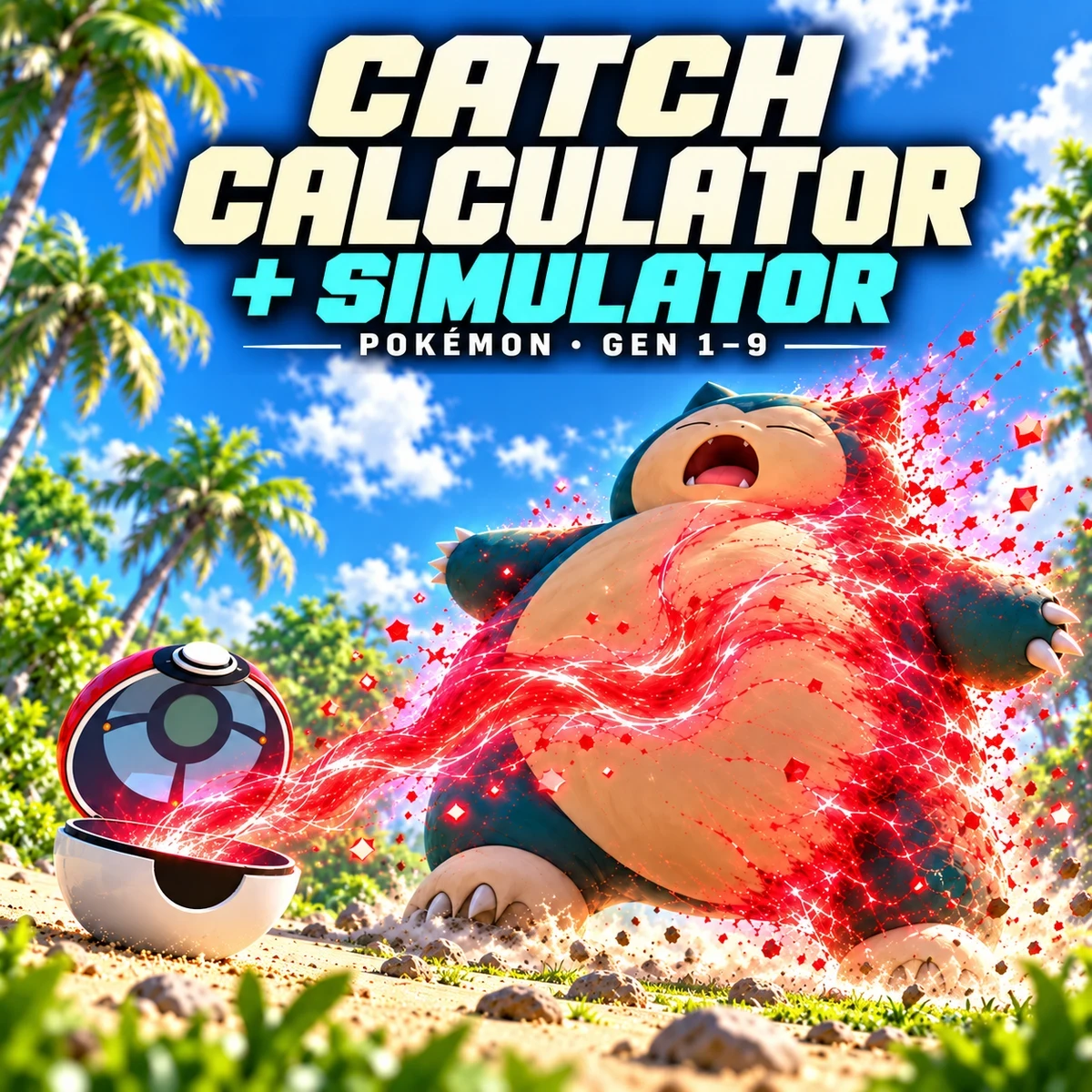
Pokémon catch rate calculator for Gen 1 to 9 — Red & Blue to Scarlet & Violet. Compare balls, HP and status, then throw in the 3D catch simulator.
Calculate Pokémon catch rates and try your setup in the catch simulator.
Published · Updated
The interactive calculator runs in your browser. Its default example, worked out for every ball:
| Ball | Per throw | Within 10 throws |
|---|---|---|
| Ultra Ball | 4.37% | 36.0% |
| Great Ball | 2.56% | 22.8% |
| Poké Ball | 1.60% | 14.9% |
| Net Ball | 1.60% | 14.9% |
| Dive Ball | 1.60% | 14.9% |
| Nest Ball | 1.60% | 14.9% |
| Repeat Ball | 1.60% | 14.9% |
| Timer Ball | 1.60% | 21.2% |
| Luxury Ball | 1.60% | 14.9% |
| Premier Ball | 1.60% | 14.9% |
| Master Ball | 100% | 100% |
Tip — Find the best matching Poké Ball: Want a ball that suits your Pokémon’s colours? Explore our Matching Poké Balls guide for normal and shiny Pokémon, then test your favourite here. Every ball can be inspected in the 3D Poké Ball viewer.
How catch rate works
Every species has a catch rate from 3 to 255: 255 for early Pokémon like Caterpie, 45 for most starters, 3 for most legendaries. Each throw combines it with the ball, the HP the Pokémon has left and its status. The ball can visibly wobble up to three times before a normal catch. These wobbles show the result of that attempt; they do not improve the odds of the next throw.
Lower HP with False Swipe
From Generation II on, a Pokémon at 1 HP is about three times easier to catch than at full health. False Swipe is the classic tool because it always leaves the target at least 1 HP. In Generation I lower HP helps too, but a full-HP target is not hopeless.
Best status for catching
| Generation | Sleep or freeze | Paralysis, burn, poison |
|---|---|---|
| Generation I | Catches outright on 25 of the first random numbers | Catches outright on 12 |
| Generation II | +10 to the final rate | Nothing — a bug in the game |
| Generation III and IV | ×2 | ×1.5 |
| Generation V to IX | ×2.5 | ×1.5 |
Tip — Sleep first, then chip the HP: Put the target to sleep, lower its HP with False Swipe, and throw while it sleeps. Re-apply sleep before it wakes rather than switching to paralysis. In Ruby and Sapphire, badly poisoned (Toxic) gives no bonus at all; ordinary poison still does.
Which ball should you use?
| Ball | Bonus | When it applies |
|---|---|---|
| Ultra Ball | ×2 | Always |
| Timer Ball | Up to ×4 | Peaks after 30 turns in Generation III and IV |
| Up to ×4 | Peaks after 10 turns from Generation V | |
| Quick Ball | ×4 | First turn only, Generation IV |
| ×5 | First turn only, from Generation V | |
| Dusk Ball | ×3.5 | At night or in a cave, Generation IV to VI |
| ×3 | At night or in a cave, from Generation VII | |
| Net Ball | ×3 | Water- or Bug-type target, Generation III to VI |
| ×3.5 | Water- or Bug-type target, from Generation VII | |
| Dive Ball | ×3.5 | Underwater after Dive, Generation III |
| ×3.5 | Surfing or fishing, from Generation IV | |
| Repeat Ball | ×3 | Species already caught, Generation III to VI |
| ×3.5 | Species already caught, from Generation VII | |
| Nest Ball | Up to ×4 | Low-level targets only |
| Master Ball | Never fails | Any wild battle |
Timer Ball vs Ultra Ball
A Timer Ball beats an Ultra Ball after 10 completed turns in Generation III and IV, and after 4 from Generation V on. Before that, throw Ultra Balls.
Why do legendaries take so many Poké Balls?
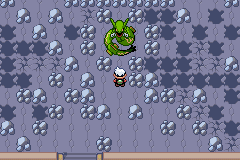
At catch rate 3, an Ultra Ball catches a sleeping Rayquaza at 1 HP on 4.37% of throws: a 50% chance takes 16 throws, a 90% chance 52. Every throw is independent, so a long run of misses is normal — bring a stack of Timer Balls for a legendary that does not flee. Roaming Latios and Latias flee on their first turn instead; see the roaming Latios and Latias guide and the Rayquaza, Groudon and Kyogre guide.
Critical captures
From Black and White on, a throw can become a critical capture: the ball wobbles once and the Pokémon gets a single check to break out. The more species you have caught, the more often it happens — never at 30 or fewer, most often past 600 — and the Catching Charm doubles it from Sword and Shield on. In Scarlet and Violet successful catches of already registered species use the one-shake animation, so it no longer tells you a throw was critical.
Species caught changes the critical-capture bonus only at 31, 151, 301, 451 and 601 distinct species, so the selector groups equivalent counts. Sword and Shield can count at most 584 Pokédex species, and Brilliant Diamond and Shining Pearl at most 493: neither can reach the 601+ tier.
Safari Zone: catch or flee
Pick a game with a Safari Zone and switch the calculator to Safari Zone to see the catch and flee chance. In Red, Blue and Yellow bait halves the catch rate but makes the Pokémon calmer, and a rock doubles it but makes it likelier to run. In FireRed and LeafGreen each species has its own flee rate: a Chansey runs on almost half of all turns.
Game-specific exceptions
| Games | What changes |
|---|---|
| Yellow | Dragonite has catch rate 9 instead of 45 |
| Gold Silver Crystal | Moon Ball never boosts |
| Love Ball boosts the same gender, not the opposite one | |
| Fast Ball only works on Magnemite, Grimer and Tangela | |
| Level Ball ignores HP and status | |
| HeartGold SoulSilver | Heavy Ball takes 20 off the catch rate of everything under 204.8 kg |
| Omega Ruby Alpha Sapphire | Rayquaza has catch rate 45 instead of 3 |
| Scarlet Violet | Bloodmoon Ursaluna has catch rate 5 instead of 20 |
Catch rate questions
- How does catch rate work in Gen 3 games like Emerald?
- In Ruby, Sapphire, Emerald, FireRed and LeafGreen the catch rate is multiplied by the ball bonus and the HP term, then sleep or freeze doubles it and paralysis, burn or poison adds half. A normal catch must pass four internal checks, with up to three visible wobbles. There are no Dusk or Quick Balls yet.
- Does a Pokémon’s catch rate change between games?
- Yes. Select the game you are playing: species catch rates and ball bonuses can differ between versions. The game-specific exceptions above show examples.
- Does badly poisoned help catch Pokémon in Ruby and Sapphire?
- No. Ruby and Sapphire leave Toxic out of the ×1.5 bonus by mistake; ordinary poison still works. Emerald, FireRed and LeafGreen fixed it.
- Is the Master Ball guaranteed to catch?
- Yes, in every main-series wild battle. It cannot be used on another trainer’s Pokémon, and raid catches follow their own rules.
Daily Pokémon location quiz on Instagram: @pokemaps_
Explore PokéMaps: Interactive Pokémon maps for every region