Love Ball
Love Ball 3D model
Back to the 3D Poké Ball viewer
More modern Poké Balls in 3D
Poké Ball 3D model · Great Ball 3D model · Ultra Ball 3D model · Master Ball 3D model · Premier Ball 3D model · Heal Ball 3D model · Net Ball 3D model · Nest Ball 3D model · Dive Ball 3D model · Dusk Ball 3D model · Strange Ball 3D model · Timer Ball 3D model · Quick Ball 3D model · Repeat Ball 3D model · Luxury Ball 3D model · Safari Ball 3D model · Fast Ball 3D model · Friend Ball 3D model · Lure Ball 3D model · Level Ball 3D model · Heavy Ball 3D model · Cherish Ball 3D model · Moon Ball 3D model · Dream Ball 3D model · Beast Ball 3D model · Sport Ball 3D model · GS Ball 3D model
Where to find it
Gifts (2)
- Conditional item rewards — conditional reward · Heahea City · Alola
- Conditional item rewards — conditional reward · Malie City · Alola
Trades (1)
Pokémon that match the Love Ball
140 Pokémon list the Love Ball as a colour match for their normal or shiny form.
- Nidoran♀ ball guide
- Nidorina ball guide
- Clefairy ball guide
- Clefable ball guide
- Venomoth ball guide
- Slowpoke ball guide
- Slowbro ball guide
- Drowzee ball guide
Browse every Pokémon matching the Love Ball
Browse Poké Balls
Poké Ball · Great Ball · Ultra Ball · Master Ball · Premier Ball · Heal Ball · Net Ball · Nest Ball · Dive Ball · Dusk Ball · Strange Ball · Timer Ball · Quick Ball · Repeat Ball · Luxury Ball · Safari Ball · Fast Ball · Friend Ball · Lure Ball · Level Ball · Heavy Ball · Cherish Ball · Love Ball · Moon Ball · Dream Ball · Beast Ball · Sport Ball
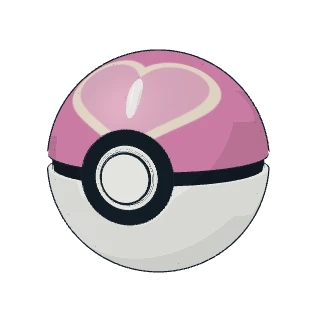
8× effectiveness on opposite sex, same species targets of the Active Pokémon. Made from Pnk Apricorn.
Category: apricorn balls
Effect notes
Used by a trainer in battle : Attempts to catch a wild Pokémon. If used in a trainer battle, nothing happens and the ball is lost. If the trainer’s Pokémon and wild Pokémon are of the same species but opposite genders, the wild Pokémon’s catch rate is 8× normal.
In-game descriptions by version
| heartgold soulsilver | Poké Ball for catching Pokémon that are the opposite gender of your Pokémon. |
|---|---|
| black white | Poké Ball for catching Pokémon that are the opposite gender of your Pokémon. |
| black 2 white 2 | Poké Ball for catching Pokémon that are the opposite gender of your Pokémon. |
| x y | A Poké Ball that works best when catching a Pokémon that is of the opposite gender of your Pokémon. |
| sun moon | A Poké Ball that works best when catching a Pokémon that is of the opposite gender of your Pokémon. |
| ultra sun ultra moon | A Poké Ball that works best when catching a Pokémon that is of the opposite gender of your Pokémon. |
| lets go pikachu lets go eevee | A Poké Ball that works best when catching a Pokémon that is of the opposite gender of your Pokémon. |
| sword shield | A Poké Ball that works best when catching a Pokémon that is of the opposite gender of your Pokémon. |
Catch rate
Love Ball: ×8 — on the same species as your Pokémon with the opposite gender; ×1 otherwise (HeartGold / SoulSilver, Generation VII, Sword / Shield, Generation IX).
Older games differ — the table shows each one.
Example in Scarlet / Violet: a full-HP Pokémon with catch rate 45, like most starters, is caught 11.9% of the time by a Poké Ball and 56.8% by the Love Ball when its bonus applies.
| Games | Effect |
|---|---|
| HeartGold / SoulSilver, Generation VII, Sword / Shield, Generation IX | ×8 on the same species as your Pokémon with the opposite gender; ×1 otherwise |
| Generation II | ×8 on the same species as your Pokémon with the same gender — the game’s gender check is reversed |
In Generation II and HeartGold / SoulSilver, the Love Ball changes the Pokémon’s catch rate itself rather than adding a separate multiplier.
Games that catch outside battle — Let’s Go, Legends: Arceus and Legends: Z-A — use their own systems and are not listed.
How the game calculates it
Generation V to IX
The game multiplies the HP the Pokémon has lost (3 × max HP M minus 2 × current HP H, over 3 × max HP) by its catch rate C, the ball’s multiplier B and the status bonus S (×2.5 asleep or frozen, ×1.5 paralysed, burned or poisoned). If X reaches 255 the Pokémon is caught. Otherwise the ball shakes: each shake passes with the chance Y ÷ 65536, and all four must pass, so the chance P is roughly (X ÷ 255) to the power ¾. Generation V uses the power ¼ and three shakes; later games add a few extra factors to X, such as low-level and badge bonuses.
For the Love Ball, B is ×8 (see the table above).
Generation III and IV
The same idea in whole numbers, rounded down at every step: lost HP times catch rate C times the ball’s multiplier B, then the status bonus S (×2 asleep or frozen, ×1.5 paralysed, burned or poisoned). At 255 or more the Pokémon is caught; otherwise four shakes must each pass with the chance Y ÷ 65536, which works out to almost exactly X ÷ 255. So in these games a ×2 ball really does double your chance.
For the Love Ball, C is the catch rate multiplied by ×8 (see the table above).
Generation II
Gold, Silver and Crystal let the ball change the catch rate itself, giving C′ (at most 255). The lost-HP fraction scales it, and a sleeping or frozen Pokémon adds 10 (the bonus meant for paralysis, burns and poison never works). One random number from 0 to 255 then decides: it catches when it is X or lower.
For the Love Ball, C′ is the catch rate multiplied by ×8 (see the table above).
What changed between generations
- Generation I: no multiplier — the ball limits the first random number and sets the HP factor.
- Generation II: the ball changes the catch rate itself; one random number decides.
- Generation III and IV: the ball becomes a separate multiplier, and four shakes decide.
- Generation V: fractions in steps of 1/4096, three shakes, critical captures and dark grass.
- Generation VI to IX: four shakes again; later games add low-level, badge and difficulty factors.